
Learning to Speak Up
My little activism

We climbed the steep wooden steps to the front door and exchanged nervous glances that said You do it. No, you do it.
Since she’s nine and I’m not, I did it. I rang the doorbell.
I don’t know if I’ve ever really done anything. For my community, I mean.
Sure, I’ve volunteered a bunch. Voted. Been a friendly neighbour. Worked at a non-profit. Written an angry letter or two.
But in this current moment, when our world feels like one crisis after another, I hadn’t done anything to help.
The advice I’ve been seeing from people in the online world is to go hyper-local. Connect with your closest communities, talk to people in real life, choose an issue and just start.
So, I started. Rather than giving all my attention away to the howls of chaos in the American news, I started paying attention right here. My city, my province, my country.
We had a city council by-election coming up, and our horrible crypto-bro of a mayor needed to be taken down a few notches. (Kicking city council members out of your party for using facts to make decisions? Cool cool.) Maybe I could find some strong candidates and encourage everyone I know to vote. That seemed doable.
I stumbled across a website with in-depth coverage of all the candidates and the recent City Hall scandals I knew nothing about. And the fact that our last by-election had 11% turnout — ugh. After spending several hours reading excellent articles, it was a no-brainer to click through and become a paying subscriber. It’s two guys, just getting out there and doing old-fashioned journalism, right here at home, telling us about things that immediately affect us. I’m not gonna lie — I don’t hate that their other main focus is restaurant reviews. Anyone who can teach me about democracy, transit planning and Blood Orange Espresso Tonic deserves my $8.99 a month!
Ok, this felt good. Learn local stuff: check. Support local stuff: check.
But what about actually doing something?
I started very small. Every day when I walk to pick my daughter up at school, I cross the street by our neighbourhood community centre and library. It’s a popular place, with families, seniors and sweaty exercisers coming and going. And almost every single day, a car runs the red light when it’s the pedestrians’ turn. People shout at the car or throw their arms up or just sigh and keep going. Me too.
It's a ridiculous intersection, and my lack of spatial awareness and my hatred of driving do not allow me to even fathom what is going on. A bunch of streets come together in a big 10-lane V, and cars can somehow turn right from a side street into either side of the V. Drivers coming from below the V can veer into either side or turn into side streets. It’s got bike lanes, stop signs and impatient cars swerving the wrong way around medians. I just stand there and wait my turn and hope for the best.
Halfway along my side of the V, there’s a random traffic light hanging from a streetlamp over on the sidewalk. This is the light they don’t see.
As another thoughtless driver whooshed through the red light, my new Do Something mindset kicked in and I decided to talk to the city. We have an app for that, so I popped into the library and took a few minutes to walk through the questions. Animals, garbage, noise, graffiti… there it was… lights, signals and signs. I chose from a list of specific problems, dropped a pin on a map, described what was going on and uploaded a photo. It was surprisingly quick and easy. Who knew?
About ten days later, when I’d sort of forgotten about it, I got this email from Brendan, a traffic engineer:
“Thank you for bringing forward your concerns about this intersection. Based on your feedback and site assessment findings, the City will be looking into making some changes to the signal operation.
The combination of the layout and high demand of the intersection makes the intersection one of the more challenging intersections to navigate and signalize. Hence, we will look into options to enhance the signal from all directions and for all road users. At this time, we are still reviewing possible options and won’t be able to confirm the specifics of the changes yet. However, you can expect to see some signal timing improvements to alleviate your concerns in the near term, likely in the 1-3 months range.”
Brendan! Really? I think I love you!
The fact that this reasonable and helpful response was so surprising made me stop and think. Do a lot of systems actually function well and we just don’t realize it? Or do we avoid trying because we think no one is going to listen to us?
That last one is going to spiral into a whole other essay because apparently, deep down, I don’t think people will listen to me.
Ok, what’s next?
Let’s try the online Ask the Principal box at our elementary school.
At age 8, our kids had been introduced to “educational” video games in their classroom, and their report cards said we should encourage playing them at home as well. What a treat to now have a small zombie even more desperate for screen time, with new behavioural issues and an inability to listen!
This fishing game where you drag your finger around the screen to win tokens and then get prompted to pay $5 a month to win better tokens sure does seem valuable.
I’d been stewing about it for a while but hadn’t done anything. Ok, just start. Say something.
My message to the principal about these mindless games was basically “Come on, really?” and “Thanks a lot.”
And surprisingly, only two days later…
Guess what, Mama? We didn’t do our game today and we have a new math game that’s really about math.
Wait, what? Did I make that happen?
Probably. I heard the teachers talking.
What did they say?
I don’t remember.
Huh. I mean, they’re still using a game, but it seems like progress!
I felt like a champ.

Quick look in the mirror: Do I realize that these things I’m doing are mostly about me rather than the greater good? Yes, totally. But now that I’ve had some practice, I feel confident that I can take my little activism to the next level.
Signs for the times
We’re monthly donors to Queer Momentum, a Canadian organization that’s doing amazing work to advocate for freedom, equality and human rights. They’ve had such cool ideas during our federal election campaign. (As you may have heard, there are a few small things on the line in this election!)
Last month I got an email asking if we’d chip in a little extra. They had designed a series of beautiful billboards about voting for love and freedom, and they were hoping to raise enough to put two billboards in twelve Canadian cities. Anyone who donated would get to choose which city to support, and that started a fun game in our house called who’s-the-most-backwards! We were happy to support this project and thrilled to find out ten days later that they’d raised enough. Fun fact: The billboards feature drag artists from the local communities.
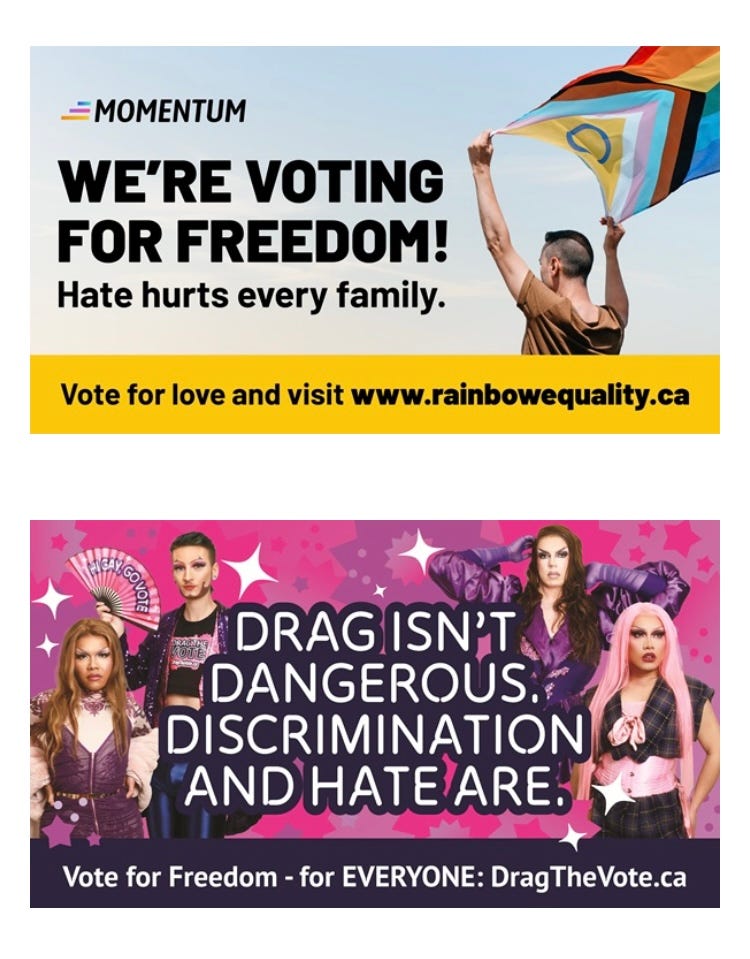
Part of Queer Momentum’s work is training advocates in every city, to amplify their message and impact. I was out of town on all the dates when it was happening locally, but I’m definitely going to watch for more opportunities. They were also looking for people to drop off flyers. How hard would it be to do that another time?
“People are doing things. You will meet those people when you start doing things.”
Sherrilyn Ifill, Democracy is Crumbling. Is Anybody Doing Anything?
Back to door-knocking
So how did I end up on that doorstep with my 9-year-old?
I was reading up on the city council by-election on that local news website, and I found my candidate almost instantly.
Lucy Maloney was new to running for office but not new to advocating for all the things that are important to us. She had years of community experience speaking up for renters, cyclists and safe streets around schools, and she’s an environmental lawyer. She was running with a party that’s all about climate justice, a sustainable economy, childcare, affordability and equity. (We have parties at the city level — weird, I know.)
Fired up to do something but a little nervous about talking up a specific candidate, I started with raising awareness. How many people could I get to vote? Maybe 50? 100? That would help.
The first steps seemed stupidly easy. Why hadn’t I done this before?
Talk to my elderly neighbours and ask if they want help getting mail-in ballots.
Write a little note encouraging people to vote and put it on the bulletin board in our mailroom.
Post a message at work sharing the election website, the dates and a link to the locations. Post again before each of the three voting days.
Send texts to all my friends. Did you know we have a city council by-election on April 5th?
Make a donation.
Order a Lucy window sign.
That’s when things got interesting.
The executive director of the party called to thank me, and she was so smart and nice. A couple out walking with their baby came by to drop off my Lucy window sign, and they were smart and nice. I met up with a campaign field director in a park to get “I love Lucy” stickers and flyers, and he was smart and nice.
We all keep trying to figure out how to build community and find our people. Guess where the smart and nice people are? Out there doing something!
Tiny activist
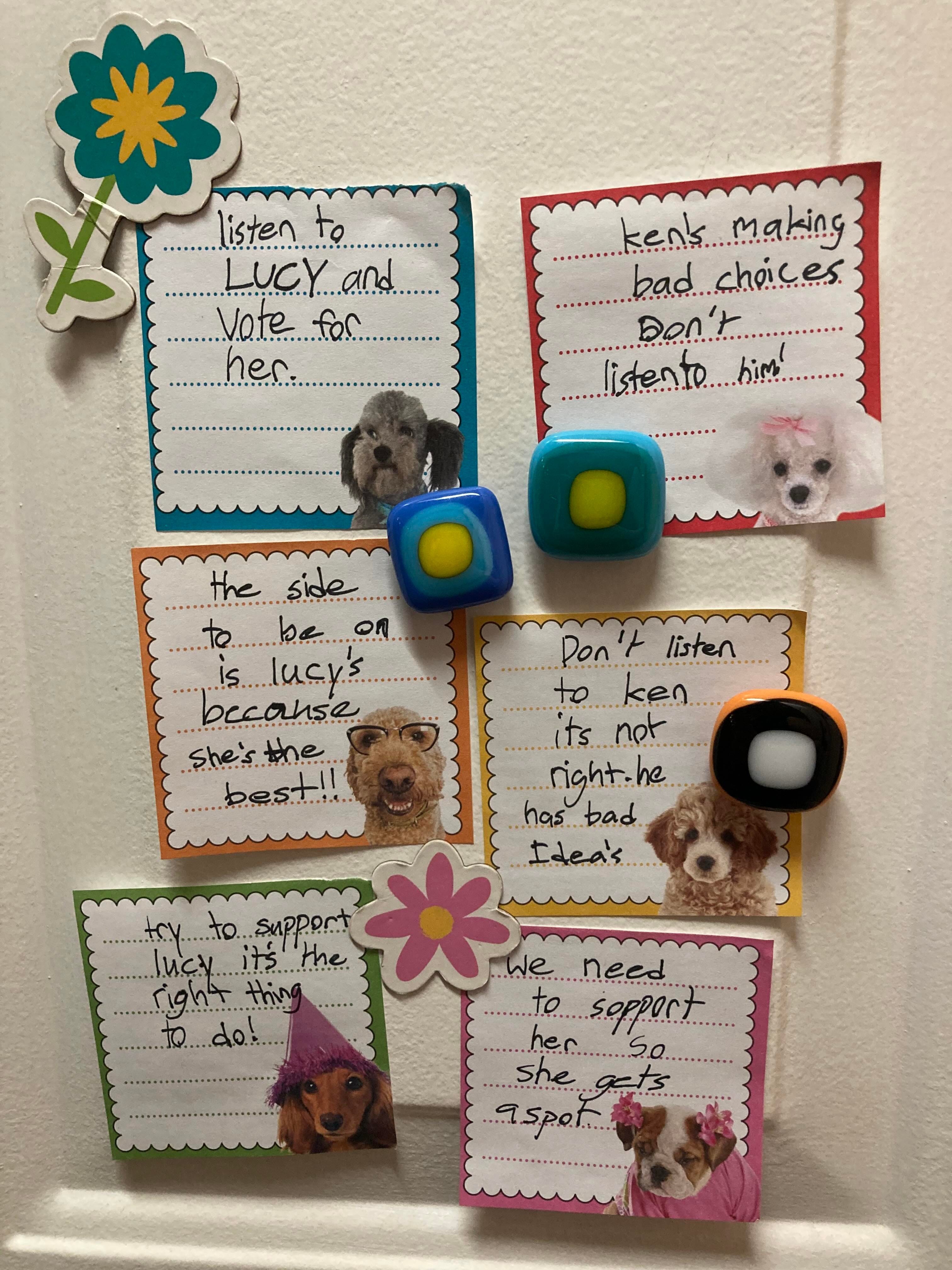
You can’t bring stickers and buttons into your house without your nine-year-old getting involved. And after maybe three minutes of me explaining city politics, Lucy and the bad mayor, my daughter was all in. She decorated our door with flyers and her own campaign slogans, musing “Maybe I should do this for a job!”
On election day, we headed out before 8:00 a.m. to help get out the vote. A fresh spring morning, Vancouver bursting with blossoms.
I didn’t know what to expect, but our job was simple — walk around to a list of addresses of Lucy’s supporters, drop off flyers and remind them to vote.
Lucy signs were everywhere. People were out and about doing Saturday morning errands. We knocked, we chatted, everyone was kind. Lots of people said they’d already voted or were on their way. (And the book boxes! We looked in so many.)
With every step we took, my delight bloomed. (And we took a lot of steps — 5 miles!) There was my little girl, charging down the street, eager to find the next house, holding her Kids for Lucy sign as drivers and walkers smiled and waved at her.
(You know what’s easy? Getting your kid to make a cute sign. A piece of cardboard taped to a pair of chopsticks — done!)
This was electric. Why on earth had I never done it? I mean, I spent my twenties wanting to marry Josh from The West Wing!
Reach out with a simple message
Here’s our best idea.
My daughter was so excited about trying to help Lucy win, and she couldn’t believe it when I said she wouldn’t be able to vote for nine more years. What?! Not fair.
The night before election day, we wrote an email to a list of friends, family and neighbours, sharing her hope that the adults in her life would vote in line with her values to help make a better future for all of us. And we included photos of her Lucy signs and a thank you on behalf of all kids.
The aunties voted. The cousins voted. And a neighbour couple went to the polls first thing in the morning and told us later, “We voted for that Lucy you told us about! We looked her up and she’s so qualified.”
Please vote
And here we are again, the night before another election. And this is the big one — Canada’s existentially frightening federal election.
I don’t think anyone I know is in danger of choosing the bad guy, but maybe their friends or family are. If every forward-thinking Canadian reached out to 10 or 20 people to remind them what’s at stake, we’d easily get to keep our smart, stable leader, known affectionately as Prime Minister Dad.
It can just be a simple message with a reminder to get out and vote. Try one of these:
The world doesn’t need another smug, abrasive man setting a bad example for our kids.
I believe in science!
Canada is over 50% women. It’s our choice. Imagine if we all showed up.
You know what? I don’t need a tax cut or more personal wealth at the expense of every other group in society.
Poilievre will let our planet burn.
Dear Mom and Dad, here’s what your choice in this election could mean for me and my kids.
Dear Young Men, …
Honestly, I don’t know how to do that last one, but somebody had better write it.
Oh wait, I found it! Danny I.P. wrote it on Substack. Here’s a fiery snippet:
“You can’t build a movement on profanity and paranoia and expect to be taken seriously.
You can’t hurl hatred like confetti and call it patriotism.
So just to be clear:
If your political identity is stitched together with F-bombs, rage slogans, and a desecrated flag—you’re not standing up for Canada.
You’re standing in the way of it.”
Yes, Danny!
(Danny’s bio: “53-year-old gay man from rural PEI, passionate about healing, justice, and fighting for equality. Animal lover, science advocate, and political junkie. Proudly dedicated to my country, Canada.”)
Say something. Do something.
People heard us
Sometimes people listen when we take the time to speak up. And even small wins feel amazing when you know you’ve had a hand in them. (Take that, video games at school!)
And if people show up to vote, guess what happens?
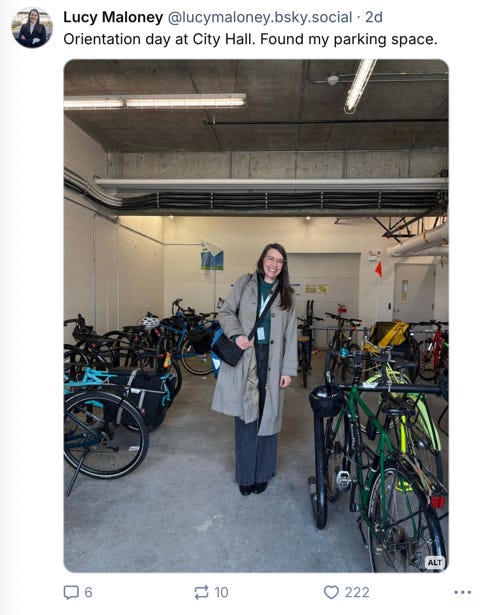
Did I mention that she won? A smart, strong, progressive woman won. In a landslide!
“She won.” Words we need to hear way more often.
These Are Nice For Us
This week’s writing vibe: Treehouse. Up on a wooden platform overlooking an enormous parkour gym. For added excitement, could fall off the edge at any moment!
Good news: I’ve already been trying to buy most things from Canada for the last 10 years, so switching to support my own country’s economy in this troubled time hasn’t taken much effort.
Appropriate: My used book store now has a shelf labelled Women’s Rage.
Wondering where the newsletter name comes from?
It was my friend’s birthday. We were having dinner at a fancy-but-not-too-fancy restaurant. I brought gifts and sprinkled little sparkly confetti all over the table. We were sipping wine and telling funny stories, and she looked at me and said, “This is nice for us.” I replied, “It is nice for us.” Now we just say it anytime that feeling pops up — comfort and fun and connection. Nice for us.
This resonates so hard: "At age 8, our kids had been introduced to “educational” video games in their classroom, and their report cards said we should encourage playing them at home as well. What a treat to now have a small zombie even more desperate for screen time, with new behavioural issues and an inability to listen!"
And awesome work!
This was precisely what I needed to read today - thank you!!